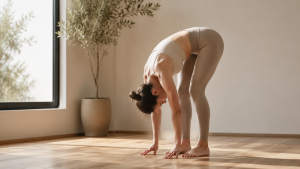
What "Easy" Really Means in a Movement Routine
Here is the honest answer: an easy full body movement routine is one you can do on your worst day. Not your best day. Not the day you feel motivated. Your worst day - when you are tired, stiff, short on time, and not in the mood.
That is the standard most beginner routines fail to meet. They call themselves "easy" but still assume you can kneel, get on the floor, or hold a plank for 30 seconds. For a lot of people - especially anyone over 50, anyone returning from injury, or anyone who has been sedentary for years - those movements are not easy. They are barriers.
This routine is different. It is 10 movements you can do in your living room with a sturdy chair. No equipment. No floor work. No kneeling. No jumping. Each movement takes about a minute. Total time: 10-12 minutes.
And before you ask: yes, this counts as real movement. The World Health Organization recommends adults get at least 150 minutes of moderate activity per week, and this kind of gentle, functional movement absolutely contributes to that. You do not need to sweat or strain for movement to matter.
Why Most "Beginner" Routines Still Fail Real Beginners
When I first started taking movement seriously, I made a classic mistake. I downloaded a "beginner-friendly" 30-day challenge app and tried to follow it on day one. By day three, I was sore in places I did not know I had muscles. By day five, I had quit entirely. It took me months to try again.
Here is what I learned: the problem was not me. It was the routine.
Most routines labeled "beginner" are designed by people who are already fit. They assume a baseline level of strength, flexibility, and body awareness that many people simply do not have yet. They also assume you can comfortably get on and off the floor, which is not a given - especially for older adults or anyone with joint issues.
The thing nobody tells you about easy movement is this: it should feel almost boringly simple. If you are wondering whether you are "doing enough," that is usually a good sign. The goal is not to challenge your body. It is to remind your body that it can still move in all the ways it is supposed to - then let consistency do the heavy lifting.
That is the philosophy behind this routine. Every movement here is one you already do in daily life: sitting, standing, reaching, twisting, bending. We are just doing them deliberately, with attention and intention.
The 10-Movement Routine
Here is the full routine. You will need a sturdy chair - the kind with four legs, not a swivel chair. A wall is also helpful for one movement. That is it.
Seated Warm-Up Movements (1-3)
Start seated. These three movements wake up your body and get blood flowing without raising your heart rate much.
Movement 1: Seated March
Sit tall in your chair with both feet flat on the floor. Place your hands on your thighs for support if needed. Lift your right knee toward your chest as high as comfortable, then lower it. Repeat with the left. Alternate for 60 seconds.
This movement wakes up your hip flexors and core stabilizers. Most people do not realize how much sitting shortens the muscles at the front of the hip. This gentle march is the first step toward reversing that - and it also gets your blood moving without requiring you to stand up.
Movement 2: Shoulder Rolls with Arm Reach
Sit tall. Roll your shoulders backward in a slow circle 5 times, then forward 5 times. Then reach both arms overhead as far as comfortable, hold for 2 seconds, and lower. Repeat the reach 5 times.
This addresses the forward-rounded shoulder posture that comes from desk work and phone use. The shoulder roll part is self-massage for your upper back. The reach part is a gentle stretch for your lats and chest. If your shoulders feel tight or crunchy at first, that is normal - it improves with repetition.
Movement 3: Seated Side Bend
Sit tall with hands on your thighs. Reach your right arm overhead and lean gently to the left, feeling a stretch along your right side. Hold for 3 breaths, then switch sides. Repeat 3 times per side.
Side bending is one of the most underrated movements in any routine. It targets your obliques and the quadratus lumborum - a deep back muscle that gets tight from sitting and is a common source of lower back discomfort. Most people feel an immediate release in their lower back after this one.
Standing Movements (4-7)
Stand up and hold the back of your chair for support. These four movements build strength and balance - two things that decline quietly with age if you do not use them.
Movement 4: Sit-to-Stand
Stand in front of your chair with feet hip-width apart. Sit back down slowly, keeping your chest up, then stand back up. That is one rep. Do 8-10 reps at a comfortable pace.
This is the single most functional movement in this routine. Sit-to-stand transfers directly to getting out of chairs, cars, and toilets. It strengthens your quads, glutes, and core. If 8 reps feels like a lot, do 4. If it feels easy, slow down the descent - that is where the real work happens. A 3-second controlled lower is significantly harder than a quick drop.
Movement 5: Standing Calf Raise
Hold the back of the chair for balance. Rise up onto your toes as high as comfortable, hold for 1 second, then lower slowly. Do 10 reps.
Calf strength matters more than most people think. It supports your balance, your gait, and your ability to climb stairs. Weak calves are one of the biggest contributors to falls in older adults. If you feel a burning sensation in your calves by rep 8, that is the muscle working - not an injury.
Movement 6: Wall Push-Up
Stand arm's length from a wall. Place your palms flat on the wall at shoulder height and width. Bend your elbows and lean your chest toward the wall, then push back to start. Do 8-10 reps.
This is a push-up for people who cannot do push-ups - and that is not an insult. Wall push-ups strengthen the same muscles (chest, shoulders, triceps) with a fraction of the load. If wall push-ups feel easy, step further back from the wall. The more horizontal your body becomes, the harder the movement gets. You can progress this over months without ever touching the floor.
Movement 7: Standing Hip Circle
Hold the back of the chair with your right hand. Shift your weight onto your left leg. Make slow circles with your right hip, as if drawing a hula hoop circle with your pelvis. 5 circles clockwise, 5 counterclockwise. Switch sides.
This movement lubricates the hip joint and improves mobility in a way that directly helps with walking, bending, and getting in and out of cars. Go slow - the slower the circle, the more control it requires. If you feel a clicking or popping sensation, that is often just gas releasing from the joint. It should not be painful.
Final Stretch Movements (8-10)
Return to your chair. These last three movements are about stretching and calming your nervous system.
Movement 8: Seated Twist
Sit tall, then rotate your torso to the right. Place your left hand on your right knee for leverage. Hold for 3 breaths, then switch sides. Repeat 3 times per side.
This is a spinal rotation, which helps maintain the twist-and-turn mobility you need for looking over your shoulder while driving or reaching for things in the back seat. It also feels genuinely good - most people hold tension in their mid-back without realizing it. If one side feels tighter than the other, that is completely normal. Spend an extra breath on the tight side.
Movement 9: Seated Hamstring Stretch
Sit on the edge of your chair. Extend your right leg straight in front of you with your heel on the floor. Gently lean forward from your hips until you feel a stretch down the back of your leg. Hold for 20-30 seconds, then switch legs.
Tight hamstrings are nearly universal among desk workers and older adults. They pull on your pelvis, which contributes to lower back pain. This stretch is safe and effective because you are seated - no balance required. Keep your back straight as you lean forward. Do not round your spine to chase a deeper stretch.
Movement 10: Overhead Reach with Deep Breath
Sit tall. Reach both arms overhead, interlace your fingers, and turn your palms to the ceiling. Take a slow, deep breath in as you reach higher. Exhale and relax your shoulders down. Repeat 5 times.
This is a full-body reset. It decompresses your spine, opens your ribcage, and forces you to breathe deeply - which is harder than it sounds for people who have been hunched over a keyboard all day. The exhale is just as important as the inhale. Make it slow and complete.
How to Schedule This Routine (and Actually Stick to It)
The routine takes 10-12 minutes. That is short enough to fit into almost any schedule, but let us be honest: "short enough" and "actually do it" are two different things.
Here is what I recommend based on what has worked for real people, not fitness influencers:
- Do it every day for the first week. Not because daily is necessary, but because it helps build the habit. At 10 minutes, the time commitment is small enough that consistency is realistic.
- Anchor it to an existing habit. Do it right after your morning coffee, or right before your evening shower. Linking the routine to something you already do automatically increases the chance you will follow through. This is called habit stacking, and it is one of the most reliable behavioral strategies we have.
- Do not skip on busy days - shorten instead. If you only have 3 minutes, do movements 1, 4, and 10. That is a warm-up, a functional strength movement, and a stretch. You have still done something meaningful.
- Morning is better for most people. Movement in the morning helps wake up your joints and sets a tone of physical activity for the day. But if you are not a morning person, evening works fine. The best time is the time you will actually do it.
If you want a slightly longer version of this approach, our daily 10-minute movement routine guide covers another full sequence you can alternate with this one to keep things fresh.
Movement Snacks: Breaking Up the Sitting Cycle
Here is a hard truth: even a perfect 10-minute routine does not cancel out 9 hours of sitting. The research is clear that prolonged sitting is independently associated with negative health outcomes, even for people who exercise regularly.
The solution is not more exercise. It is movement snacks.
Movement snacks are exactly what they sound like: 1-2 minutes of movement scattered throughout your day. They do not need to be structured. They just need to interrupt sitting. Think of them as micro-doses of activity that keep your body from settling into stillness for hours at a time.
Some examples that require zero planning:
- Stand up and do 5 calf raises while your coffee brews.
- Walk to the bathroom on the other side of the building.
- Do 3 sit-to-stands from your office chair every hour.
- Stretch your arms overhead and roll your shoulders while on a phone call.
- Take a 2-minute walk around your block after lunch.
If you work at a desk, incorporating short movement breaks into your workday can make a bigger difference than any single workout. We have written a separate guide on movement breaks at work that covers this in detail, including specific strategies for fitting them into meetings and deadlines without feeling awkward.
The key insight: your body was designed to move frequently, not intensely. A 10-minute routine plus hourly movement snacks is a far better pattern than a 60-minute workout followed by 8 hours of stillness. The person who does 10 minutes of gentle movement plus hourly 1-minute breaks is likely getting more overall benefit than the person who does one intense gym session and sits for the rest of the day.
Common Mistakes and How to Avoid Them
Even an "easy" routine has pitfalls. Here is what I have seen go wrong - both in my own practice and with people I have worked with.
Mistake 1: Pushing through pain
There is a difference between discomfort (a stretch, mild muscle fatigue) and pain (sharp, stabbing, or joint-specific). If something hurts, stop. Modify the movement or skip it. This routine is designed to be adaptable - there is no movement here that is essential enough to hurt for.
Mistake 2: Holding your breath
It is surprisingly common. People focus so hard on the movement that they forget to breathe. If you notice you are holding your breath, that is a sign you are working harder than you need to. Slow down and exhale on the effort. Breathing is not just a background function - it is part of the movement.
Mistake 3: Doing the routine once and expecting results
Movement is a cumulative thing. One session feels good. Ten sessions feel better. Thirty sessions change how your body works. Nobody gets the benefit from a single workout - it is the repetition that creates change. This is where most people quit, and it is also where the people who succeed separate themselves.
Mistake 4: Comparing yourself to what you used to do
This is the one that stops people cold. If you used to run marathons or lift heavy weights, it is easy to feel like this routine is "beneath" you. But here is the thing: your current body is the only one you work with. Meeting it where it is now is not a weakness. It is the smartest thing you can do. The ego gets in the way of progress more than any physical limitation.
Mistake 5: Using a chair that is not stable
I cannot stress this enough. Use a sturdy dining chair or similar. Not a rolling office chair, not a folding chair, not something on wheels. Falls are a real risk, and the whole point of this routine is to be safe and accessible. Check that the chair does not slide on your floor. If it does, place it against a wall.
When You Are Ready for More
This routine is not meant to be the end of your movement journey. It is the beginning. But how do you know when to progress?
Here are signs you are ready:
- The routine feels genuinely easy - not "I can do it" but "I am a little bored."
- You can do all 10 movements without needing a break.
- You notice yourself moving more easily in daily life - stairs feel easier, getting up from the floor is less of an event.
When you are ready, here is how to progress safely:
- Add reps. Increase sit-to-stands from 8 to 12, calf raises from 10 to 15.
- Slow down the eccentric. Take 3-4 seconds to lower yourself in the sit-to-stand. This dramatically increases the difficulty without adding any load.
- Move the wall push-up further from the wall. Each step back increases the load on your chest and arms. Over months, you can work your way to a counter-height push-up, then a low table, then eventually the floor.
- Add a second round. Do the whole routine twice, with a 2-minute rest in between. This is a significant step up in total volume.
The progression principle is simple: when something becomes easy, make it slightly harder. Not dramatically harder - slightly. A 5-10% increase is plenty. Trying to jump from easy to hard is how people re-injure themselves and quit.
The Bottom Line
An easy full body movement routine does not have to be complicated, equipment-heavy, or intimidating. It just needs to be something you can actually do, consistently, without pain or dread.
This 10-movement routine checks those boxes. It is 10-12 minutes. It uses a chair and a wall. It covers all the major movement patterns: sitting, standing, reaching, twisting, bending, and balancing. And it is genuinely easy - not "easy for a fit person" but easy for anyone.
Start today. Do the routine once. Then do it again tomorrow. That is the whole secret - not intensity, not duration, not perfect form. Just showing up, day after day, and letting your body remember what it is capable of.
Your body has been moving your whole life. It has not forgotten how. It just needs a gentle reminder - and 10 minutes a day is enough to give it one.