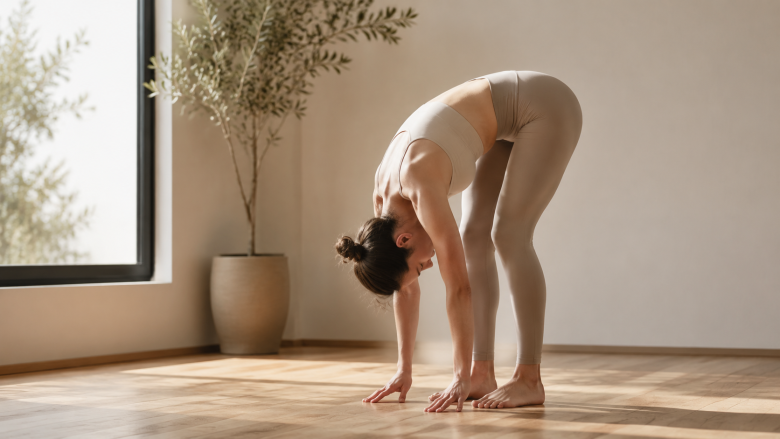
The Problem: Why Static Stretching Isn't Working for You
If you've been stretching for weeks or months and still feel tight, you're not alone. I spent years in that exact spot, doing 20 minutes of hamstring and hip stretches every morning, only to feel just as stiff by lunchtime. The frustrating part was that I was doing everything "right" - holding each stretch for 30 seconds, breathing, staying consistent. But my body never seemed to learn to let go.
Then I discovered something that changed how I think about flexibility entirely. The tightness you feel isn't always about the physical length of your muscles. Often, it's your nervous system holding on to tension as a protective response, especially if you live with chronic stress, sit for long hours, or have a history of injury. No amount of pulling or forcing will convince it to release if it doesn't feel safe.
This is where gentle movement for flexibility takes a different route. Instead of treating your body like a piece of taffy to be stretched out, you treat it like a conversation. You learn to sense where you're holding tension, breathe into that area, and move within a tiny, comfortable range - typically around 5-10% of your full effort - to send a signal of safety to your brain. Over time, your nervous system gets the message: you don't need to brace anymore. And that's when real, lasting flexibility shows up.
This approach is called somatic stretching, and it's the missing piece in most flexibility advice. Let me show you how it works and why it might be the gentle movement practice you've been looking for.
What Is Somatic Stretching? A Different Definition of "Gentle"
Most flexibility programs define "gentle" as slow speed and low intensity. They tell you to ease into a stretch, hold it for 30 seconds, and not bounce. That's fine, but it still treats the body as a mechanical system of muscles and joints. Somatic stretching adds a whole other layer: the brain. It's based on the idea that your muscles are always under the command of your nervous system, and that many cases of chronic tightness are actually learned tension patterns - your brain has gotten used to keeping certain muscles partly contracted, even when you're not actively using them.
The term "somatic" comes from the Greek word "soma," meaning the living body as experienced from within. In practice, that means paying close attention to internal sensations - what's called interoception - rather than just trying to achieve a visual pose. Instead of asking "How far can I go?" you ask "What am I feeling right now, and where exactly do I feel it?"
This isn't the same as stretching a muscle to its end range. It's closer to what animals do naturally when they wake up: they yawn, arch their back, and lengthen their limbs in a slow, voluntary contraction that releases tension. This movement is called pandiculation, and it's the basis of many somatic exercises. You actively contract a muscle group gently (not hard), then slowly release that contraction while lengthening the muscle. This sequence resets the resting tension in your nervous system, telling it, "You don't need to be on guard here anymore."
Compared to static stretching, which involves holding a passive position, somatic stretching is active and mindful. It's also more effective for people whose tightness is stress-related rather than purely structural. If you have genuinely short muscles from years of poor posture or heavy training, you might still benefit from traditional stretching. But for the vast majority of people who sit at desks, carry stress in their shoulders, and feel tight all over without a clear structural cause, somatic work often produces faster and more durable results.
The Core Framework: Sensation Mapping and the 5-10% Effort Rule
The most powerful tool I've learned from somatic stretching is something called sensation mapping. It's a simple but profound practice that turns your body into a roadmap of stored tension. Before you ever move, you close your eyes and take a slow mental scan from the top of your head down to your toes. You're not looking for pain or injury; you're looking for places that feel tight, heavy, numb, or just "off."
Most people are shocked at how much they feel once they actually pay attention. For me, it was my jaw and the tops of my shoulders. I had no idea I was clenching all day until I tried this. The act of noticing itself starts the release, because it brings your conscious awareness to a place your brain had been ignoring.
Once you've identified a tension spot, you don't dive into a deep stretch. Instead, you work with the 5-10% effort rule. That means you recruit only a tiny fraction of the muscle's capacity - just enough to feel a subtle engagement, not a strong contraction. For example, if you feel tightness in your lower back, you might gently arch your spine an inch or two, barely moving, and hold that for a breath. Then you slowly release back to neutral, letting the muscles soften completely.
The key is to stay within a range where you feel no pain, no pulling, and no strain. This is not about working through discomfort. It's about teaching your nervous system that you can move in this area without needing to brace. When you stay in this small range and pair it with slow, diaphragmatic breathing - inhaling through your nose for 4 counts, exhaling through your mouth for 6 - you activate the parasympathetic nervous system, which is responsible for rest and digestion. That's the signal your body needs to lower its guard.
I remember the first time I tried this on my chronically tight hip flexors. Instead of lunge-stretching until I felt a burn, I lay on my back, gently lifted one leg an inch off the floor, and let it drop. I repeated that five times, each time focusing on the sensation in my hip. After about two minutes, I felt a warmth spread through the area, and my hip suddenly felt lighter. That was the moment I realized flexibility wasn't about forcing anything.
"Flexibility is not about how far you can stretch. It's about how much your nervous system is willing to let go." - This is the core principle of somatic stretching.
A Simple Somatic Stretching Routine for Total Beginners
You don't need any equipment or a lot of time to start. Here's a sequence I often share with clients who are new to this approach. It takes about 10 minutes and can be done on a yoga mat or even a carpeted floor. The goal is not to feel a deep stretch but to feel a sense of release and ease.
1. Body Scan and Breath Awareness (2 minutes)
Lie on your back with your knees bent and feet flat on the floor. Close your eyes and place one hand on your belly. Breathe slowly in through your nose, letting your belly rise, and out through your mouth, letting your belly fall. As you breathe, mentally scan your body from head to toe. Notice any areas that feel tight, heavy, or tense. Don't try to change anything yet. Just observe.
2. Gentle Neck and Shoulder Release (2 minutes)
Still lying down, turn your head slowly to the right as far as feels comfortable without strain. Then slowly return to center. Repeat to the left. Do this 4 times each side. Then, with your arms at your sides, gently shrug your shoulders toward your ears, only 10% of your full effort. Hold for one breath, then slowly let them sink back down. Repeat 5 times. As you release, imagine your shoulder blades melting into the floor.
3. Pelvic Tilts for Lower Back and Hips (2 minutes)
With knees bent, press your lower back gently into the floor. You'll feel a subtle engagement in your core and glutes. Hold for a second, then slowly release so your back arches naturally. Repeat 10 times, moving slowly and staying in a pain-free range. Focus on the sensation in your lower back and hips. This movement helps reduce the protective tension that often builds up from sitting all day.
4. Leg Lowering for Hip Flexor Release (2 minutes)
Lie on your back with both legs extended. Bend your right knee and bring it toward your chest. Then, while keeping your knee bent, slowly lower your foot toward the floor, but only until you feel the first hint of stretch in your hip. That's your 5-10% range. Stop there, take a breath, and then gently pull your knee back toward your chest. Repeat 8 times, each time focusing on letting go of any gripping in your hip. Switch to the other leg.
5. Full Body Yawn (2 minutes)
End with a full-body movement. Stretch both arms overhead and both legs long, like you're waking up in the morning. Reach your fingers and toes away from each other, but only at 20% of your full stretch. Hold for one breath, then slowly release everything at once. Repeat 3 times. This mimics pandiculation and helps reset your entire nervous system.
After the routine, take a minute to lie still and notice how your body feels. You might feel a sense of lightness or even a slight tremor in a muscle - that's normal and a sign that your nervous system is releasing stored tension.
The most common mistake beginners make is trying to push into a deeper stretch because they think more is better. Resist that urge. If you feel a strong pull, you've gone too far. Back off to where you can move easily and breathe. This is not about how flexible you can become in one session; it's about building a new relationship with your body over time.
Who Should Use This Approach - and Who Needs Extra Caution
Somatic stretching is incredibly safe, but it's not a one-size-fits-all solution. If you're generally healthy and just feel tight, this method can be a great addition to your routine. But there are specific populations who need to adapt it carefully.
Hypermobile Individuals
If you have joint hypermobility (often called being double-jointed), you might already have more range of motion than average. The problem isn't that you can't stretch far; it's that your joints may be unstable because the supporting muscles aren't engaging properly. For you, gentle movement for flexibility should focus less on lengthening and more on building strength and control at your end range. The 5-10% effort rule is perfect here, but you should also include isometric holds to improve joint stability. Avoid any stretch that feels like it's pulling your joint beyond its natural limit.
Chronic Pain Conditions (Fibromyalgia, Chronic Fatigue, etc.)
If you live with chronic pain, your nervous system is already on high alert. Traditional stretching can sometimes trigger a flare-up because it feels threatening to your brain. Somatic stretching is often more tolerable because it keeps you in a tiny range and emphasizes safety. However, you should start with even less - maybe 2-3% effort - and only move in positions you can fully relax in. Listen to your body's signals. If a movement causes sharp pain, stop. If it just feels uncomfortable, try slowing down your breath first.
Post-Injury or Post-Surgery
After an injury or surgery, your brain will naturally guard the affected area to prevent further damage. Somatic stretching can help you regain movement without re-injuring yourself, but you must work within the limits your physical therapist has set. Always get clearance from your healthcare provider before starting any new movement practice. The key is to move slowly and never force a range that isn't ready.
On the other hand, if you're an athlete looking to increase flexibility for performance, you might need to combine somatic work with more traditional dynamic stretching and strength training. Somatic stretching alone won't give you the extreme ranges needed for gymnastics or martial arts, but it can help you move more efficiently and reduce the risk of injury from overstretching.
Making Gentle Movement a Daily Practice
The magic of somatic stretching doesn't come from doing it once a week. It comes from repetition and consistency. Your nervous system learns through patterns, so the more often you practice noticing tension and releasing it, the quicker your body will default to a relaxed state instead of a guarded one.
That doesn't mean you need an hour-long session every day. In fact, short, frequent practices are more effective than long, occasional ones. A 10-minute routine in the morning or before bed can be enough. If you're pressed for time, you can even do a micro-practice at your desk: close your eyes for 30 seconds, scan your shoulders, and do a gentle shrug-and-release. These small moments add up.
For a structured evening practice, our gentle evening stretch plan pairs nicely with the somatic approach because it emphasizes slow, breath-led movements that calm your nervous system before sleep. If you work at a desk, you might also benefit from our guide on incorporating short movement breaks at work - it includes several 2-minute moves that follow the same principle of gentle awareness.
And if you're looking for a quick, all-in-one session, our daily 10-minute movement routine can be adapted to include somatic elements. Just replace the dynamic stretches with the sensation-mapping exercises I described earlier.
What Realistic Progress Looks Like (and What to Expect When It Goes Wrong)
One of the biggest misconceptions about somatic stretching is that it's a quick fix. It's not. In my experience, most people notice a subtle sense of release after the first session - that "lighter" feeling in the muscles you worked with. But lasting flexibility changes take time because you're rewiring neural patterns that may have been in place for years.
Here's a realistic timeline based on what I've seen in clients and experienced myself:
- Week 1: You'll feel more aware of your tension patterns. You might notice clenching in places you never realized. That's a win.
- Weeks 2-4: You'll start to feel a difference in the specific areas you're working on - less tightness in your hips, shoulders, or back. You may also find that your breathing becomes easier during movement.
- Months 2-3: The changes become more structural. You'll notice you can move into deeper ranges without pain, because your nervous system is starting to trust that it's safe.
- Beyond 3 months: The practice becomes second nature. You'll automatically breathe into tension when you feel it, and you'll find that your body recovers faster from stress.
But this path isn't always linear. You'll have days where you feel tighter than before - often after a stressful event, poor sleep, or a long period of sitting. That's normal. Your nervous system is responding to real threats, not just physical ones. Instead of getting frustrated, treat those days as opportunities to practice your skills. Do an extra body scan, slow your breathing, and move even more gently.
Another thing nobody tells you about somatic stretching is that it can bring up unexpected emotions. When you release chronic tension, you're also releasing the stress that created it. Some people feel a sudden wave of sadness, anxiety, or even relief. If that happens, don't push it away. Just acknowledge it, keep breathing, and stop the movement if you need to. Over time, these emotional releases become less intense as your body learns to let go more efficiently.
There are also moments where you might think you're "doing it wrong" because you don't feel a stretch at all. That's okay. Somatic stretching is about sensing, not forcing. If you feel nothing, try slowing down even more or reducing the range of motion. The goal is to notice the subtle, not the dramatic.
Conclusion: Flexibility Is a Conversation, Not a Battle
If you've been stuck in a cycle of stretching, feeling tight, stretching harder, and still feeling tight, I invite you to try a different approach. Gentle movement for flexibility doesn't have to mean giving up and accepting your limitations. It can mean giving your body the safety it needs to release what it's been holding onto for years.
Start with a simple body scan. Notice where you're holding tension. Breathe into that space. Move with just 5-10% effort and see what happens. You might be surprised at how much your body has been waiting for permission to let go.
Remember, flexibility isn't a prize you win through effort. It's a state of ease that emerges when you learn to listen to your body. That's the real power of somatic stretching - and it's available to you right now, in this moment, exactly where you are.