Movement Breaks Are Not Just for Kids
When you search for movement break ideas, you are flooded with results about Freeze Dance, animal walks, and games designed for a classroom of seven-year-olds. If you are an adult who works at a desk, a senior looking to stay mobile, or someone who has been sedentary for a while, those suggestions are useless and frankly, a little discouraging. You do not need to jump, crawl, or mimic a crab to get the benefits of a movement break.
A movement break is simply a short pause from whatever you are doing to shift your body and reset your nervous system. It can be two minutes. It can be ten minutes. It can be done entirely in a chair. The goal is not to get sweaty or to burn a specific number of calories. The goal is to interrupt prolonged sitting, reduce stiffness, and give your brain a rest so you can return to your task with better focus.
This guide is for absolute beginners. It is for the person who has not exercised in years, the person with knee pain, the person who feels self-conscious moving in front of coworkers, and the person who just wants to feel less stiff at the end of the day. We will cover how to start, what to do, and how to modify everything based on how you actually feel.
Why You Need a Break (And Why It Feels So Hard)
I have worked with clients who swore they could not take a break because they had too much work. The real issue was that they felt guilty. We have been conditioned to believe that productivity means constant output. But the science suggests otherwise. According to the World Health Organization, adults should limit sedentary time and replace it with physical activity of any intensity. Even light activity has health benefits.
When I first started taking movement breaks myself, I made the mistake of trying to do too much. I set a timer for five minutes and attempted a series of deep squats and lunges. I was sore for two days and dreaded the next break. The thing nobody tells you about starting a movement habit is that the barrier is not physical, it is psychological. If the break feels like a workout, you will avoid it. If the break feels like a relief, you will crave it.
The key is to start embarrassingly small. I mean that in the kindest way possible. A two-minute seated stretch is a legitimate movement break. It counts. You do not need to earn the right to move your body.
The Real Difference Between a Break and a Workout
Many people skip movement breaks because they think, "Why bother if it is not a real workout?" This is a misconception. A workout is designed to stress the body to create adaptation. A movement break is designed to do the opposite: to release tension and improve blood flow without adding stress. These are different goals requiring different approaches.
If you approach a movement break with workout energy, you will likely overdo it and quit. Instead, think of it as hygiene. You brush your teeth to maintain your teeth, not to become a dentist. You take a movement break to maintain your joints and attention span, not to run a marathon.
The "Start Here" Progression Guide
If you are brand new to this, do not jump to the activity list. Follow this progression for the first two weeks. It is designed to build consistency before intensity.
Week 1: The 2-Minute Seated Baseline
- Set a timer for 2 minutes.
- Remain seated in your chair.
- Do only the seated exercises from the list below (neck rolls, shoulder shrugs, ankle circles, seated spinal twist).
- Do this once per day, every day, regardless of how you feel. The goal is to build the habit of pausing.
Week 2: The 5-Minute Mixed Break
- Set a timer for 5 minutes.
- Start standing for the first 2 minutes (holding onto a chair for balance).
- Perform the standing exercises (marching in place, calf raises, wall push-ups).
- Sit down for the final 3 minutes and do the seated stretches.
- Do this 3 times this week, not every day. Allow your body to recover.
Week 3 and Beyond: Listen to Your Body
- You can now mix and match. Some days you may need more stretching, other days more circulation.
- The rule of thumb: the break should leave you feeling better than when you started. If it does not, reduce the intensity or duration.
Most people do not realize that the first week is not about physical change. It is about proving to yourself that you can stop working for two minutes and the world will not end. That mental shift is the foundation for everything else.
A Practical Toolkit: 12 Movement Break Ideas for Adults
Here is a curated list of movements that require zero coordination, zero jumping, and zero special equipment. Each one includes a modification for limited mobility. Pick 2-3 movements for each break and rotate them.
Seated Movements (The Safest Place to Start)
1. Neck Rolls - Sit tall with your shoulders relaxed. Gently drop your right ear toward your right shoulder. Roll your chin down toward your chest, then over to the left shoulder. Do not roll your head backward (this compresses the neck). Complete 5 slow rolls in each direction.
2. Shoulder Shrugs and Circles - Lift both shoulders up toward your ears as high as you can. Hold for 2 seconds, then drop them heavy. Repeat 10 times. Then, roll your shoulders backward in big circles 10 times, and forward 10 times. This releases the trapezius muscles that get tight from typing.
3. Seated Spinal Twist - Sit sideways in your chair or keep both feet flat on the floor. Place your left hand on your right knee. Gently twist your torso to the right, looking over your right shoulder. Breathe deeply for 3 breaths, then switch sides. This helps with lower back stiffness.
4. Ankle Circles and Point-Flex - Extend one leg forward. Circle your ankle 10 times clockwise, then 10 times counterclockwise. Then, point your toe and flex your heel 10 times. Repeat on the other leg. This is crucial for circulation and preventing swollen ankles during long sits.
5. Seated Marching - Sit tall, hold the edge of your chair for support if needed. Lift your right knee toward your chest as high as comfortable, lower it, then lift your left knee. Alternate slowly for 30 seconds. This engages the hip flexors and gets blood moving without standing.
Standing (But Supported) Movements
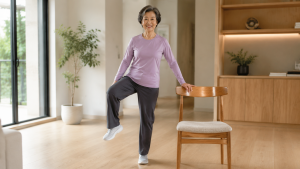
6. Standing Calf Raises - Hold onto a sturdy chair back or a countertop. Stand with feet hip-width apart. Slowly rise up onto your toes, hold for 1 second, and lower back down. Do 10-15 reps. This strengthens the calves and improves balance, which is critical for fall prevention as we age.
7. Wall Push-Ups - Face a wall, place your palms flat on the wall at shoulder height, slightly wider than your shoulders. Step your feet back a foot or two. Bend your elbows and lower your chest toward the wall. Push back to start. Do 10 reps. This is a safe way to work the chest and arms without getting on the floor.
8. Chair-Assisted Squats - Stand in front of a sturdy chair, facing away from it. Lower your hips toward the chair until you feel it touch the back of your thighs. Push through your heels to stand back up. If you are a beginner, just tap the chair and stand up. Do not fully sit down unless you want to. Do 8-10 reps.
9. Marching in Place - Stand tall, holding a counter or chair with one hand for balance. Lift your right knee to a comfortable height (hip height is ideal but not required), lower, then lift your left knee. March slowly for 1 minute. Keep your chest up and breathe normally.
Desk-Friendly Stretches (No One Will Even Notice)
10. Wrist and Finger Stretch - Extend your right arm in front of you, palm up. Use your left hand to gently pull your fingers down toward the floor. Hold for 15 seconds. Then flip your hand palm down and gently press your fingers down. This is a lifesaver for anyone who types all day.
11. Chest Opener at the Desk - Clasp your hands behind your back. Straighten your arms and gently lift them away from your body. Open your chest and look slightly up. Hold for 20 seconds. Do not force it if your shoulders are tight; just let your hands rest on your lower back instead.
12. Eye Palming - Rub your palms together vigorously for 10 seconds to generate heat. Gently cup your palms over your closed eyes, resting your fingertips on your forehead. Do not press on your eyeballs. Breathe deeply for 30 seconds. This is a movement break for your eyes and your brain, especially if you have been staring at a screen.
A good rule of thumb: pick one movement for your neck/shoulders, one for your spine, and one for your legs. That covers the three zones that suffer most from sitting.
How to Fit Movement Breaks Into a Real Workday
Knowing the movements is only half the battle. The harder part is remembering to do them when you are buried in emails and deadlines. I have been there. You look up and it is 3 PM, and you have not moved since 9 AM.
The most effective strategy I have found is to anchor the break to an existing habit. Do not rely on willpower. Willpower is a finite resource that gets depleted by your actual job. Instead, attach the break to something you already do.
- Anchor to hydration: Every time you fill your water bottle, do 5 calf raises while you wait for the water to cool.
- Anchor to the phone: When you stand up to take a scheduled phone call, do it while marching in place or doing a supported squat.
- Anchor to the bathroom: On your way back from the restroom, take the long route or do a wall push-up against the hallway wall.
- Anchor to email: After you send a difficult email, take 60 seconds to roll your shoulders and do a spinal twist.
For a deeper dive on structuring this into your professional life, see our guide on how to incorporate short movement breaks at work. The key is to remove the decision-making process. You do not decide if you will take a break; you decide when the trigger happens.
The Science of the Micro-Break
Research from the Cornell University Ergonomics Research group suggests that taking micro-breaks every 20-30 minutes is more effective than taking one long break every 2 hours. The goal is to interrupt the static posture before stiffness sets in, not to fix it after the damage is done.
This is counterintuitive. Most people think, "I will take a 15-minute walk at lunch and that will be enough." But the research indicates that shorter, more frequent breaks are better for reducing musculoskeletal discomfort. A 2-minute break every 30 minutes adds up to about 16 minutes of movement over a 4-hour period, but it is spread out in a way that keeps your joints lubricated and your mind fresh.
The thing nobody tells you about micro-breaks is that they are also a powerful tool for ADHD. If you struggle with attention, waiting for a 15-minute break is a recipe for distraction. A 2-minute movement break can serve as a "reset button" that helps you reorient and refocus on your task. It provides a small burst of sensory input that can satisfy the brain's need for stimulation.
Movement Breaks for ADHD and Focus
If you have ADHD, you likely already know that sitting still for long periods is agonizing. The standard advice to "just focus" is not helpful. What works is giving your brain a structured opportunity to move. Movement breaks for ADHD are not about rest; they are about regulation.
For adults with ADHD, a movement break should include a cognitive component. This is where you can adapt the classic "brain break" concept. Instead of just stretching, you can do a sequence of movements that requires memory. For example: March in place 4 times, then do 2 shoulder rolls, then 1 squat. Repeat that sequence 3 times. The mental effort of remembering the pattern engages the prefrontal cortex, which can help with executive function.
Another effective strategy is to use a visual timer. Set a timer for 25 minutes of work followed by 5 minutes of movement. The visual countdown helps the ADHD brain understand that the work period is finite, which makes it easier to start. During the 5-minute break, do any of the movements listed above, but do them with the goal of feeling your heartbeat increase slightly. This is not about cardio; it is about giving your nervous system a change of state.
If you are working from home, you have the advantage of space. Use it. Walk to another room and back. Do a few wall push-ups. If you are in an office, be discreet. A trip to the printer can be a movement break if you do a few calf raises while you wait for the pages to print.
For more ideas on quick, structured physical activity, check out our beginner guide to 5-minute home workouts. The principles of short, focused intervals apply directly to movement breaks.
Safety First: How to Move Without Hurting Yourself
I cannot stress this enough: the most common reason people stop taking movement breaks is that they hurt themselves. They try to stretch a cold muscle too aggressively, or they lose their balance in a standing pose. You must treat safety as the highest priority, especially if you are a senior or have a chronic condition.
Rule #1: Never stretch into sharp pain. You should feel a gentle pulling sensation, not a stab. If you feel a sharp pain, stop immediately. You cannot stretch your way out of an injury, and pushing through pain will only make the problem worse.
Rule #2: Hold onto something. For any standing exercise, keep one hand on a sturdy chair, a countertop, or a wall. There is no shame in this. The goal is to improve your balance, not to test it. Every year, thousands of adults are injured by simple falls in their own homes. Do not let a movement break be the cause of a fall.
Rule #3: Breathe. It sounds obvious, but most people hold their breath when they are concentrating on a movement. Holding your breath increases blood pressure and creates unnecessary tension. Inhale when you prepare for the movement, exhale as you perform it. For example, in a squat, inhale as you lower down, exhale as you stand up.
Rule #4: Check in with your doctor. If you have osteoporosis, recent joint replacement, or a balance disorder, talk to your physician before starting any new movement routine. They may have specific restrictions. For example, if you have osteoporosis, you may need to avoid spinal twists and forward flexion. A physical therapist can give you a personalized list of safe movements.
I once had a client who ignored the advice to hold onto a chair during a squat. She lost her balance, fell, and sprained her wrist. She was out of commission for a month. That one incident set her movement practice back by months because she became afraid to try again. Do not let that be you. Use the support.
What Is a Good Break Activity? (Beyond Movement)
Movement is the focus here, but it is worth acknowledging that a good break activity can also be a mental shift. If you are feeling overwhelmed, a 2-minute movement break that includes a mindfulness component can be more effective than either movement or rest alone.
Here is a simple protocol I use with clients who are stressed:
- Stand up (or sit tall if standing is not possible).
- Take 3 deep breaths, inhaling through your nose and exhaling through your mouth.
- Do 5 shoulder rolls backward and 5 forward.
- Reach both arms overhead and stretch to the right, then to the left.
- Shake out your hands and feet for 10 seconds.
- Take one final deep breath and sit back down.
This takes exactly 90 seconds and combines gentle movement with breath awareness. It is a good break activity because it addresses both the physical tension and the mental stress simultaneously. For a deeper exploration of how to connect movement and mindfulness, you might enjoy our guide on the beginner guide to mindful eating, which applies the same principle of paying attention to the present moment in a different context.
When to Move vs. When to Rest
An honest guide to movement breaks must acknowledge that sometimes, the best break is to do nothing. If you have had a terrible night of sleep, are fighting off a cold, or feel deeply exhausted, forcing yourself to move may not be helpful. The stress hormone cortisol is already high. Adding physical stress can backfire.
Here is how to decide:
- If you feel stiff and antsy, move. Your body is asking for circulation.
- If you feel sleepy and drained, rest. Put your head down on your desk for 2 minutes or just close your eyes and breathe.
- If you feel emotionally overwhelmed, try a gentle movement break with a focus on breathing. The movement can help metabolize the stress hormones.
This is a trade-off that most fitness content ignores. They assume more movement is always better. But the truth is that your body needs a balance of stress and recovery. A movement break is a form of active recovery. It is not a replacement for sleep or a break from mental strain.
Building a Sustainable Habit: A Simple Framework
To finish, here is a framework I use called the "3-3-3 Rule" for movement breaks. It is simple enough to remember and flexible enough to adapt to any schedule.
First 3: Take up to 3 movement breaks per day. This is a realistic goal for most people. It is better to do 3 short breaks than to plan 6 and do 0.
Second 3: Keep each break to at least 3 minutes. Less than this is not enough to change your state. More than 10 minutes is great, but do not let perfection be the enemy of good.
Third 3: Include 3 different movement types in each break. For example: one stretch (like a spinal twist), one strength move (like a wall push-up), and one mobility move (like ankle circles). This ensures you are covering different aspects of physical function.
Use this framework for the first month. After that, it will become automatic. You will notice that you feel less stiff at the end of the day, and your focus during work hours will be sharper. That is the reward.
Remember, the goal is not to become a paragon of fitness. The goal is to feel better in your body right now. Start with 2 minutes seated. Do that today. Then do it again tomorrow. That is all it takes to begin.