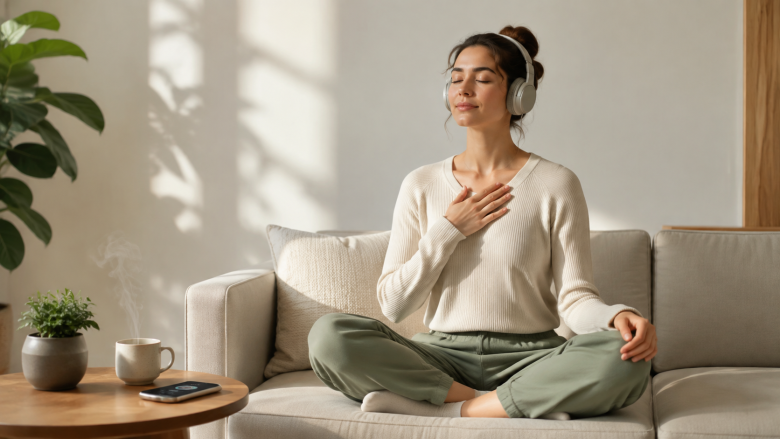
Why Most "Music for Stress" Advice Fails (And What to Do Instead)
If you have ever tried to calm down by putting on a "relaxing playlist" and felt nothing change, you are not alone. The problem is not that music does not work. It is that most advice treats music like a one-size-fits-all pill, when in reality, the same song that helps you unwind after work can make you more agitated during a panic attack. After years of using music both personally and with clients who struggle with chronic stress, I have learned that the missing piece is not the music itself, but the intentional pairing of the right sound with the right state and the right technique.
Here is the core answer in one sentence: To relieve stress with music, you must first identify your stress type (acute panic, chronic burnout, or mental fatigue), then choose a track with a specific tempo and rhythm that matches or gradually lowers your heart rate, and finally pair it with a deliberate body-based technique like paced breathing or progressive muscle relaxation. Without that third step, you are just listening, not intervening.
Most people don't realize that music is not a passive experience. Your nervous system responds to rhythm as a signal for safety or danger. The trick is to use that signal intentionally.
I learned this the hard way. When I first started using music for stress, I made the mistake of always reaching for slow, ambient tracks during moments of high anxiety. It made things worse. My heart was racing at 100 beats per minute, and the 60 BPM music felt like a mismatch, almost like a musical itch I could not scratch. It was only when I learned about the concept of "entrainment" - the way your heart rate unconsciously syncs to the tempo of the music you are listening to - that I understood my error. You cannot jump from 100 BPM to 60 BPM without going through 90, 80, and 70. That is the foundation of the personalized prescription below.
The Stress Type Quiz: What Kind of Stress Are You Actually Feeling?
Before you choose a single track, take 30 seconds to identify your current state. There are three distinct stress profiles, and each responds to a different musical approach. You might switch between them depending on the day, so this is not a personality label. It is a real-time diagnostic.
- Acute Panic/Anxiety: Racing heart, shallow breathing, sweaty palms, a feeling of impending doom. This is the fight-or-flight response in full swing. You need music that matches your current heart rate first, then gradually slows it down.
- Chronic Burnout/Exhaustion: You feel numb, drained, physically heavy, and mentally foggy. Your nervous system is actually in a state of collapse, not hyperarousal. You need music with a steady, grounding rhythm that does not demand anything from you, plus a technique that restores a sense of safety.
- Mental Fatigue/Rumination: You are not panicking, but your mind will not shut off. You are replaying conversations, planning tomorrow, and feeling scattered. You need music that provides a "cognitive anchor" - something with enough structure to occupy your verbal brain but not so much that it demands attention.
Most stress relief advice lumps these together. That is a major error. A 140 BPM dance track might be perfect for acute panic (because it matches your heart rate and then you can switch to a slower track), but it would be terrible for burnout. A gentle piano piece might soothe burnout but do nothing for rumination because it does not give your brain a pattern to follow.
The Personalized Prescription: A Decision Tree for Choosing Music
This is the framework I use with my clients. It is not a playlist. It is a set of rules that lets you build your own playlist on the fly, based on your state and your environment.
Step 1: Identify Your Stress Type (from above)
If you are unsure, take your pulse for 15 seconds and multiply by 4. If it is above 90, you are in acute territory. If it is below 60 and you feel exhausted, you are in burnout. If it is normal but your mind is racing, you are in rumination.
Step 2: Choose the Tempo and Genre
Here are the specific rules I have found to work, based on both research and trial-and-error.
- For Acute Panic: Do not start with slow music. Start with a track that matches your current heart rate (if you measure 100 BPM, find a track at 100 BPM, which is often pop or upbeat electronic). Listen for 2-3 minutes. Then switch to a track at 80 BPM (soft rock, some hip-hop). Then after another 2 minutes, switch to 60 BPM (ambient, classical adagio). This step-down approach is called "rhythmic entrainment" and it is far more effective than cold-turkey slow music. I have seen it work in real-time with clients who were mid-panic.
- For Chronic Burnout: You need grounding, not stimulation. Choose music with a steady, repetitive rhythm around 60-70 BPM, but with a strong bass line or a consistent percussive element. Think tribal drumming, deep house without vocals, or even the soundtrack to a slow documentary. The key is that the rhythm is predictable. Your nervous system needs to feel that the world is stable. Avoid music that has sudden changes in volume or tempo. Also avoid music that is emotionally evocative (like sad piano) because you already feel empty.
- For Rumination: Your brain needs a task that is not your thoughts. Choose music with a clear, repeating pattern that you can follow mentally. This could be a minimalist piece by Philip Glass, a loop-based electronic track, or even a song with a strong, repeating bassline. The idea is to give your "inner monologue" something to track. You are not trying to relax your body; you are trying to distract your verbal mind. I often recommend listening to music in a language you do not understand, or instrumental versions of songs you know well, because your brain will try to fill in the lyrics and that keeps it occupied.
Step 3: Pair It With a Physical Technique
This is the step that most articles miss. Music alone is not enough. You have to combine it with a body-based practice that amplifies the effect. Here is the pairing for each stress type:
- Acute Panic + 4-6 Breathing: Inhale for 4 counts, exhale for 6 counts. The longer exhale activates the parasympathetic nervous system. Do this while you listen to the step-down tracks. The music gives you a tempo to breathe to, and the breathing gives the music a physical anchor. I have found that counting breaths to the music's beat is the most effective way to slow your heart rate down.
- Burnout + Progressive Muscle Relaxation (PMR): While listening to grounding music, tense each muscle group for 5 seconds, then release for 10. Start from your toes and work up. The steady rhythm of the music guides the pace. This works because burnout often involves physical tension that you are not consciously aware of. The music keeps you present in your body, and the PMR releases the stored stress.
- Rumination + Focused Attention: Pick one instrument in the music (the bassline, the hi-hat, the melody) and follow it for the entire track. Whenever your mind wanders to a stressful thought, gently bring it back to the instrument. This is a form of mindfulness meditation, but the music acts as your anchor instead of your breath. I have found that people who cannot sit still for breath meditation can do 10 minutes of this easily.
Micro-Routines: How to Fit This Into a Busy Day
The second major gap in most advice is that it assumes you have 30 minutes of silence and a comfortable chair. Real life does not work that way. Here are three micro-routines that I personally use and recommend, each under 10 minutes, each designed for a specific time of day.
The Commute Reset (7 minutes)
You are stuck in traffic or on a crowded train. Your stress is acute (road rage, lateness). Put on a track at your current heart rate (you can guess based on how you feel). Use the 4-6 breathing technique while you drive or stand. After 3 minutes, switch to a 60 BPM track. By the time you park or arrive, your heart rate should have dropped by at least 10-15 beats per minute. Do not do this with headphones if you are driving; use the car stereo. The point is not to isolate yourself, but to create a bubble of rhythm.
Deep Work Anchor (10 minutes before a difficult task)
If you have to write a report, have a hard conversation, or study, you are likely in rumination mode. Put on a looping, patterned track (I use a 70 BPM minimal techno instrumental). Set a timer for 10 minutes. During the first 2 minutes, just focus on the pattern. Then start your task while the music continues. The music acts as a cognitive anchor that keeps your verbal brain from spiraling. I have found that this works better than silence because silence allows your mind to wander. The music gives you a "rail" to run on.
The 5-Minute Burnout Rescue
You are at your desk, feeling drained, unable to move. Do not reach for caffeine. Put on a steady 60 BPM track with a strong percussive beat. Lie back in your chair (or on the floor if you can). Do a quick PMR sequence: tense shoulders for 5 seconds, release for 10; tense fists for 5, release for 10; tense jaw for 5, release for 10. Do this for the duration of the track. This is not a nap. It is a nervous system reset. I have used this after back-to-back meetings and it genuinely restores a sense of physical energy without the crash of a nap.
What to Do When Music Makes Things Worse (And Why That Happens)
Sometimes, despite all the right choices, music can actually increase your stress. This is a real phenomenon, and it is important to know how to handle it. There are three common reasons this happens, and each has a fix.
Reason 1: You Are Listening to Music That Is Too Emotionally Charged
If you choose a song that you associate with a painful memory, or a piece that is highly expressive and melancholic, your brain will follow the emotional content, not the tempo. This is especially dangerous for burnout because you might be drawn to sad music that validates your exhaustion, but it actually deepens the low mood. The fix: choose music that is emotionally neutral. Instrumental music, or music in a language you do not understand, is safer. Save the emotional music for when you are feeling stable and want to process feelings, not when you are trying to regulate.
Reason 2: You Are Using Headphones That Emphasize High Frequencies
Most in-ear headphones boost treble frequencies (the "sparkle") which can increase feelings of agitation. For stress relief, you want a warm, bass-heavy sound. Over-ear headphones with a flat response, or even a speaker, are better. I have noticed that listening to the same track on my laptop speaker versus my high-quality headphones produces a completely different physiological response. The headphones can be too "sharp". If you feel jittery after listening, try switching to a different output device.
Reason 3: You Are Trying to Use Music to Avoid Your Stress
This is the biggest trap. Music is not an escape. If you use it to push away a problem, your brain will still be processing the stress in the background, and the music will feel like a distraction that you cannot fully engage with. The fix: before you press play, spend 30 seconds acknowledging what you are stressed about. Say it out loud or write it down. Then choose your music and technique. The music becomes a tool for dealing with the stress, not a shield against it. This is the difference between passive and active listening.
When I first started this practice, I used music to avoid dealing with a difficult work situation. I would put on calming music and try to forget. It never worked. The moment the music stopped, the anxiety came back stronger. It was only when I used the music to help me breathe through the anxiety, while also acknowledging the source, that I felt a lasting change.
Combining Music with Other Stress Relief Techniques for Synergy
You can multiply the effect of music by combining it with other evidence-based techniques. Here are three combinations that I have found to be particularly powerful, and they go beyond the simple breathing and PMR already mentioned.
1. Music + Cold Exposure (for Acute Panic)
If you are in a panic state and have access to cold water, the physiological sigh (two inhales through the nose, one long exhale through the mouth) combined with music at 60 BPM is a rapid reset. The cold water triggers the dive reflex, which slows your heart rate. The music provides a rhythmic template for the exhale. I have used this in the bathroom at work. Splash cold water on your face for 20 seconds while listening to a slow track. The combination is faster than either alone.
2. Music + Journaling (for Rumination)
Instead of trying to stop your thoughts, write them down while listening to patterned music. The music keeps your brain in a semi-focused state, which allows you to dump your thoughts onto paper without spiraling. After you finish writing, you can listen to a slower track and do breathing. This is a two-step process: first externalize the stress, then regulate the body. I have found that journaling to music works better than journaling in silence because the music prevents the inner critic from editing your words.
3. Music + Walking (for Burnout)
Burnout often comes with physical heaviness. The best way to combat this is gentle movement. Put on a track with a steady beat at 60-70 BPM and walk in time with the beat. This is essentially rhythmic walking, which has been shown to reduce cortisol. The key is to match your steps to the beat. This forces your body to move at a steady, non-stressed pace. I recommend a 15-minute walk during a lunch break. The combination of music, movement, and fresh air is a potent anti-burnout cocktail.
The Tempo and Genre Cheat Sheet (Your Quick Reference)
Here is a summarized table you can bookmark or screenshot. It condenses everything above into a quick reference for when you are in the moment and cannot think clearly.
| Stress Type | Starting Tempo (BPM) | Genre Examples | Target Tempo (after 3-5 min) | Pair With |
|---|---|---|---|---|
| Acute Panic | Your current heart rate (90-120) | Upbeat pop, electronic, dance | 60-70 BPM | 4-6 breathing, step-down method |
| Chronic Burnout | 60-70 BPM | Deep house (instrumental), tribal drumming, ambient with bass | Stay steady | Progressive muscle relaxation |
| Rumination | 70-90 BPM | Minimal techno, Philip Glass, looping instrumental | Stay steady | Focused attention on one instrument |
Note: BPM stands for beats per minute. You can find the BPM of any song using a free online tool like Song BPM or by tapping your foot to the beat and counting for 15 seconds, then multiplying by 4.
Five Tips for Reducing Stress (That You Can Apply Right Now)
These are not generic tips. They are the distillation of everything above into five actionable steps. This is the answer to the question "what are five tips for reducing stress?" but with a musical twist.
- Take your pulse before you press play. Know your stress type. This is the single most important step. Do not guess. Measure.
- Use the step-down method for acute stress. Start with a track that matches your heart rate, then gradually lower the BPM. Never jump straight to slow music.
- Pair music with a physical technique. Breathing, PMR, or focused attention. Music without a physical anchor is just background noise.
- Keep a "stress relief" playlist that is sorted by BPM, not by genre. This way you can quickly find the right track for your current state. I have three playlists: one for panic (fast to slow), one for burnout (steady 60 BPM), and one for rumination (patterned loops).
- Use music as a tool, not an escape. Acknowledge your stress first, then use the music to regulate your nervous system. Avoid using music to suppress feelings.
Ten Ways to Relax with Music (Beyond Just Listening)
If you are looking for a broader list of ways to relax, here are ten specific, practical applications of music for stress relief. These go beyond the standard "listen to classical music" advice and incorporate the principles of active listening.
- Sing or hum along. Humming stimulates the vagus nerve, which is directly linked to the parasympathetic nervous system. Choose a song you know well and hum it, even if you do not know the lyrics. The vibration in your throat is the key.
- Play an instrument, even badly. You do not need to be a musician. Just pressing keys on a piano or strumming a guitar with no regard for melody forces your brain to focus on motor control, which pulls you out of rumination. I keep a cheap ukulele in my office for this purpose.
- Dance, but not in a coordinated way. Put on a track with a strong beat and move your body freely. The goal is not to dance well, but to release physical tension. This is especially effective for burnout because it gets your blood moving without the pressure of a workout.
- Use music as a timer for breathing exercises. Choose a track that is exactly 5 minutes long. Breathe in for 4 beats, out for 6 beats, and let the music tell you when to switch. This is more effective than counting on your own because the music removes the mental effort.
- Create a "sound bath" in your own home. Use a speaker, not headphones, and play ambient music at a low volume while you do a simple chore like washing dishes or folding laundry. The music fills the space and changes the emotional tone of the task.
- Listen to binaural beats (but with a caveat). Binaural beats are a perceptual phenomenon where you hear two different frequencies in each ear, and your brain creates a third frequency. Some studies suggest that delta waves (1-4 Hz) are associated with deep relaxation. However, you need headphones for this to work. I have found that binaural beats are best for sleep or deep meditation, not for active stress relief. Use them sparingly.
- Match music to your breathing rate. Inhale for 4 seconds, exhale for 6. That is about 6 breaths per minute. Find a track with a 6-second loop (often in ambient music) and breathe in sync. This is a more advanced version of the 4-6 breathing technique.
- Use music to shift your emotional state intentionally. If you feel sad, do not listen to sad music. Choose a track that is slightly more energetic than your mood, but not too much. This is called "emotional pacing." You move your mood in small increments, not leaps.
- Record your own relaxation track. This is a personal favorite. Use your phone to record yourself reading a calming script (like a guided meditation) over a background of gentle music. Then listen to your own voice. This is incredibly effective because your own voice is the most familiar sound to you, and it can trigger a relaxation response more quickly than a stranger's voice.
- Make a "stress release" playlist for specific triggers. If you know that a certain task (like paying bills) makes you anxious, create a playlist that you only listen to during that task. Over time, your brain will associate the music with the task and automatically start to relax before you even begin. This is a form of classical conditioning.
The Truth About Music and Stress: What Research Really Says
You do not need to be a scientist to use music for stress, but understanding the mechanisms can help you choose better. The most robust research points to two main pathways: the physiological (heart rate, cortisol) and the psychological (mood, distraction).
According to a review in the journal Frontiers in Psychology, music listening has been shown to reduce cortisol levels and heart rate, but the effect is highly dependent on the type of music and the context. The review notes that "music that is perceived as relaxing" is not always the same as "music that produces a relaxation response." This is exactly why the personalized prescription is necessary.
Another key finding is that the tempo of music can influence heart rate variability, which is a marker of stress resilience. A study from the American Psychological Association found that listening to music after a stressful task can help you recover faster, but the effect was stronger when participants chose their own music rather than being assigned a generic "relaxing" track. This supports the idea that personal preference and intentionality matter more than the genre itself.
However, the research is not conclusive on every claim. Binaural beats, for example, have mixed evidence. A meta-analysis in the Journal of Alternative and Complementary Medicine found that binaural beats can have a small effect on anxiety, but the quality of studies is low. I mention this because it is important to be honest about what we know and what we do not. Music is not a miracle cure. It is a tool that works best when combined with other techniques and used with intention.
One thing nobody tells you about music and stress is that the act of choosing the music is itself a stress-reducing behavior. When you stop and think, "What do I need right now?" you are engaging in a self-assessment that interrupts the stress spiral. The music is secondary to that moment of awareness. That is why I always recommend that you take your pulse and identify your stress type before you even look at your playlist. The assessment is half the battle.
Your 7-Day Music Stress Relief Challenge
To put this into practice, here is a simple 7-day plan. Each day, you will practice one of the techniques above, and by the end of the week, you will have a personalized toolkit that you can use for the rest of your life.
- Day 1: Identify your dominant stress type. Use the quiz above. Take your pulse at three different times of day (morning, midday, evening) and note the pattern.
- Day 2: Build a "panic" playlist with three tracks: one at your typical high heart rate, one at 80 BPM, and one at 60 BPM. Use the step-down method during a stressful situation.
- Day 3: Create a "burnout" playlist with steady 60-70 BPM tracks. Practice PMR while listening for 10 minutes.
- Day 4: Create a "rumination" playlist with patterned music. Practice focused attention on one instrument for 10 minutes.
- Day 5: Try the commute reset. Use music and 4-6 breathing during your commute, whether you are driving or on public transport.
- Day 6: Combine music with journaling. Write about a stressor while listening to patterned music for 10 minutes, then switch to slow music and do breathing for 5 minutes.
- Day 7: Reflect. Which technique worked best? Which stress type do you encounter most often? Write down your go-to routine for each type.
After this week, you will not need a generic playlist. You will have a personalized music prescription that is based on your own physiology and your own stress patterns. That is the difference between passive listening and active stress intervention.
Remember, music is not a substitute for professional help if you are dealing with severe anxiety or depression. But for everyday stress, it is a powerful, accessible, and free tool that is underutilized because most people do not know how to use it correctly. Now you do.