Why Home Feels So Much More Stressful Than the Office
Stress at home is different from stress at work. At the office, there are physical cues that tell your brain when it's time to focus and when it's time to leave. You walk through a door, sit at a desk, and the environment itself shapes your behavior. At home, those cues disappear. The same couch holds your laptop, your coffee, and your evening snack. The bedroom doubles as a meeting room. The kitchen table is both a workspace and a dinner spot.
When I first started working from home, I didn't realize how much this blurred reality was driving my anxiety. I'd finish a stressful call, walk three steps to the kitchen, and still feel my heart racing while I made lunch. I'd close my laptop at 6 PM, but my brain kept replaying emails. The stress wasn't coming from the work itself - it was coming from the lack of separation between work and rest. Most people don't realize that home stress is often an environmental problem, not a mental one. You can't just "relax" if your space keeps reminding you of everything you haven't finished.
The solution isn't another meditation app or a better to-do list. It's about architecting your space and your schedule to create psychological boundaries. In this guide, I'll share the two frameworks that completely changed how I handle stress at home: micro-zones and transition rituals. These are practical, grounded methods that address the root cause - the lack of separation - rather than just listing coping mechanisms.
Home stress is often an environmental problem, not a mental one. Fix the environment, and the mental fog lifts.
The Problem: Blurred Boundaries and Sensory Overload
Before you can fix anything, you need to understand what's actually causing your stress at home. There are two main culprits: blurred boundaries and sensory overload.
Blurred boundaries happen when your brain can't tell when work ends and rest begins. Without a physical commute or a different location, your nervous system stays on high alert. You check work messages from the couch, answer emails from bed, and never truly disconnect. A study from the American Psychological Association found that people who work from home report higher stress levels due to the inability to "switch off" mentally. The lack of separation means your stress hormones don't get a chance to reset.
Sensory overload is the second hidden stressor. Your home is full of visual noise - clutter, laundry, dirty dishes, stacks of papers. Each item is a tiny reminder of unfinished tasks. Your brain processes these as threats, keeping you in a low-grade fight-or-flight state. Add in noise from roommates, family, or street traffic, and you have a constant stream of micro-stressors. Competitors often tell you to "declutter" as a one-time fix, but that's not enough. You need to design your environment so it actively signals relaxation, not just reduce the mess.
The Solution: Micro-Zones - Designing Your Space for Psychological Separation
A micro-zone is a tiny, dedicated area in your home that serves one specific psychological purpose. It doesn't need to be a separate room - it can be a corner of a room, a chair, or even a window sill. The key is that this zone is used exclusively for one state of mind. When you sit there, your brain learns to associate that spot with a particular activity or feeling.
I first started using micro-zones after realizing that my one-bedroom apartment was causing me constant anxiety. I couldn't create a separate office, so I created three zones: a work zone at my desk, a decompression zone in a corner of the living room, and a sleep zone (my bed, only for sleeping). The change was immediate. When I sat in my decompression corner, I stopped thinking about work because that spot never saw a laptop. It was only for reading, journaling, or listening to music.
How to Create a "No-Talk" Corner
The most powerful micro-zone for stress relief is what I call a "no-talk" corner. This is a spot where you physically cannot be reached by anyone - no conversations, no phone calls, no video meetings. It's a decompression zone where you go when you need to reset your nervous system.
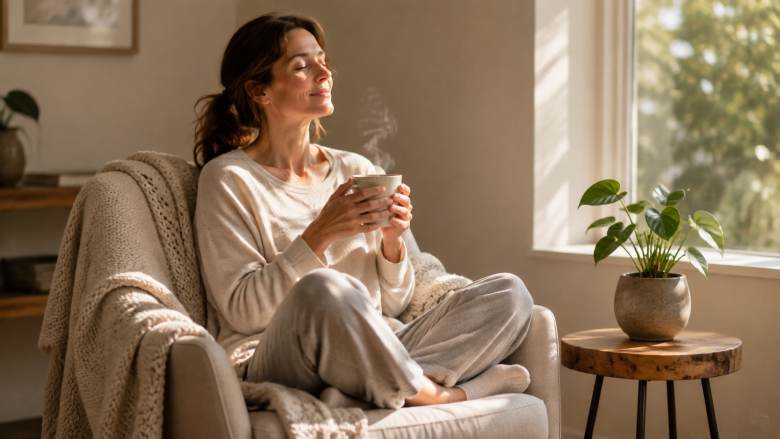
Here's how to set one up: choose a chair, a floor cushion, or even a patch of carpet away from high-traffic areas. Put it near a window if possible - natural light is a proven mood booster. Add a small side table with a single item: a book, a journal, or a stress ball. That's it. No electronics. No work materials. When you sit here, you commit to staying for at least 5 minutes without speaking or checking your phone.
The reason this works is that it creates a strong contextual cue. Your brain starts to associate that specific spot with safety and rest. When I first tried this, I made the mistake of putting my phone on the table "just in case." It didn't work. I'd see a notification and feel a spike of anxiety. Once I removed all devices, the corner became a true sanctuary. If you live with others, communicate clearly that when you're in this corner, you're off-limits unless it's an emergency. It sounds rigid, but it saves more stress than it creates.
Lighting as a Stress Signal
Lighting is one of the most underrated tools for managing stress at home. Your body's circadian rhythm is deeply tied to light exposure, and the wrong lighting can keep you in a state of alertness even when you're trying to relax.
Use cool, bright light (around 5000K) for work zones - it mimics daylight and keeps you focused. For your decompression zone, switch to warm, dim light (around 2700K) - this signals your brain to produce melatonin and wind down. The thing nobody tells you about lighting is that it's not just about brightness; it's about color temperature. I bought a cheap smart bulb for my living room lamp, and I set a timer to shift from cool to warm at 6 PM every day. That simple change made my evenings feel dramatically more restful.
If you can't install smart bulbs, use a floor lamp with a warm bulb for your evening reading spot. Keep the overhead lights off after dinner. This creates a visual "sunset" in your home that tells your nervous system it's time to relax. If you live with others, you can have a conversation about "lighting rules" - it sounds silly, but it works.
The 5-Minute Commute Ritual
One of the biggest losses when working from home is the commute. That transition time - however annoying it was - gave your brain a buffer between work and home life. Without it, you're just one click away from your inbox at all times.
The solution is to simulate a commute. It doesn't have to be long. A 5-minute walk around the block is enough to signal to your brain that the workday is over. I did this every day for a month, and it was the single most effective habit I've ever adopted. Here's the key: the walk must be done consistently at the same time, and you must not bring your phone. Just walk, breathe, and notice the sky. If you can't go outside, walk from your desk to the front door and back, or do a quick lap around your apartment. The movement and change of scenery reset your spatial memory.
When I first tried this, I felt silly. I'd put on my shoes, walk out the door, and think, "I'm just going to come back in 5 minutes." But after a week, I noticed that my evening anxiety dropped significantly. The walk became a ritual that told my brain, "Work is done." If you have a partner or kids, invite them along - it becomes a family transition ritual that helps everyone shift gears.
Transition Rituals: How to Bookend Your Workday
Transition rituals are structured routines you perform at the beginning and end of your workday. They create a clear psychological boundary that prevents stress from leaking into your personal time.
I learned this the hard way. For the first two years of remote work, I'd roll out of bed, open my laptop, and immediately start checking emails. My stress levels were through the roof by 10 AM. It wasn't until I started treating the start and end of my day with the same intentionality as a gym workout that things changed. A transition ritual doesn't need to be elaborate - it just needs to be consistent and distinct from your regular activities.
The Morning Kickoff
The morning kickoff is a 10-15 minute routine that prepares your mind for focused work. It's not about checking emails or scrolling social media - it's about mental preparation. Here's what works for me:
- Wake up at the same time every day, even on weekends (within an hour).
- Drink a glass of water before any caffeine.
- Do a 5-minute breathing exercise (I'll share a specific one later).
- Write down your top 3 priorities for the day on a sticky note.
- Then, and only then, open your laptop.
The key is to avoid starting your day with reactive work. If you check emails first thing, you're letting others dictate your stress. By starting with a breathing exercise and a priority list, you set the tone. For a guided breathing routine, see our Beginner Guide to Simple Home Breathing Exercises - it's a great starting point if you're new to this.
The Shutdown Ritual
The shutdown ritual is the evening counterpart. It's a deliberate process of closing out your workday so your brain can let go. This is where the 5-minute commute fits in, but you can also add these steps:
- At a set time (say, 5:30 PM), close all tabs and save your work.
- Write a "tomorrow list" of unfinished tasks - this gets them out of your head.
- Shut down your computer completely (not just sleep mode).
- Change out of your work clothes into something comfortable.
- Do your 5-minute walk or movement break.
I remember when I first started doing this, I felt a weird sense of loss. My brain was so used to being "always on" that stopping felt uncomfortable. But after a few weeks, the shutdown ritual became the best part of my day. It's like closing a door behind you - you're protected from the noise inside.
If you live alone, this is easier. If you have family, you need to communicate your boundaries. "From 5:30 to 6 PM, I'm unavailable unless the house is on fire." It's not selfish; it's necessary for your mental health.
When Cohabitation Friction Spikes Stress
If you live with a partner, roommates, or family, the home stress can be multiplied by constant interaction. The same physical space that should be a sanctuary becomes a source of tension. I've been there - sharing a one-bedroom apartment with my partner during the pandemic. We were both working from home, and we drove each other crazy.
The biggest mistake we made was assuming that because we loved each other, we could work in the same room without issues. We couldn't. The sound of typing, the different meeting schedules, and the constant presence of another person raised our stress levels. We had to create clear micro-zones for each other, and we had to establish "quiet hours" when we wouldn't interrupt each other.
Here's what works for cohabiting stress: agree on specific areas that are "yours" and "mine" during work hours. Use headphones with noise canceling. Set up a shared calendar for meetings so you know when to be quiet. And most importantly, have a "no-work talk" boundary after a certain hour. When you're both done, you need to physically move to a different part of the house - maybe the living room - and leave work behind.
If you're feeling resentful about your living arrangement, that's a sign you need stronger boundaries. It's not about avoiding each other; it's about respecting each other's need for psychological separation. The transition rituals become doubly important when you cohabitate, because you both need to signal to each other that the workday is over.
What to Do When You're Alone and Overwhelmed
Being alone at home can be a double-edged sword. On one hand, you have total control over your environment. On the other, loneliness and isolation can amplify stress. When you're by yourself, there's no one to bounce ideas off, no one to remind you to eat lunch, and no one to distract you from your spiraling thoughts.
I've had days when the silence felt oppressive and my anxiety was through the roof. The worst part was that I didn't know how to break the cycle. That's when I developed a simple emergency protocol for extreme stress and anxiety. It's not a long-term solution, but it's something you can do right now, in your home, to bring your nervous system down.
The 5-4-3-2-1 Grounding Technique
This is a classic technique, but it works best when you've prepared your environment. Here's the version I use at home:
- 5: Look around and name 5 things you can see (a lamp, a book, a plant, a wall, a rug).
- 4: Touch 4 things you can feel (the fabric of your chair, the floor, your own skin, a cushion).
- 3: Listen for 3 sounds you can hear (a hum, a bird, your own breathing).
- 2: Smell 2 things (your coffee, a candle, or the air).
- 1: Taste 1 thing (a sip of water, a mint, or just your tongue).
This technique forces your brain to focus on sensory input rather than racing thoughts. It's especially effective if you've set up a calm micro-zone - sit in your no-talk corner and do this. I've used it after panic-inducing video calls, and it brings my heart rate down within minutes.
If you're experiencing extreme anxiety that doesn't subside, it's important to seek professional help. You can call or text the 988 Suicide & Crisis Lifeline in the US or your local emergency number. There's no shame in needing support beyond self-help.
Practical Stress Management Exercises That Fit Your Home Environment
Exercise is one of the most effective stress relievers, but you don't need a gym to benefit. The problem with generic advice like "just exercise" is that it ignores the reality of your home space. You might not have room for a yoga mat, or you might be too stressed to think clearly. That's why I'm sharing specific exercises that are designed for small, cluttered, or unconventional spaces.
First, let's talk about breathing. Deep breathing stimulates the vagus nerve, which activates the parasympathetic nervous system - your "rest and digest" mode. The most effective technique I've found is box breathing: inhale for 4 seconds, hold for 4, exhale for 4, hold for 4. Repeat for 5 minutes. I do this in my no-talk corner, sitting upright with my feet flat on the floor. For a step-by-step guide, see our Beginner Guide to Simple Home Breathing Exercises - it covers several variations including box breathing and the 4-7-8 method.
Second, movement. You don't need to do a 30-minute workout to reduce stress. In fact, a 10-minute movement routine can be more effective for stress relief than a long workout because it's easier to fit into a busy day. The key is to focus on movements that release tension in your shoulders, neck, and hips - the areas where stress tends to accumulate. Try this quick sequence: shoulder rolls (10 each direction), neck stretches (30 seconds each side), and a standing forward fold (hold for 1 minute). For a full 10-minute routine, check out our Daily 10-Minute Movement Routine at Home - it's designed for small spaces and requires no equipment.
If you have just 5 minutes, try a simple bodyweight circuit: 10 squats, 10 push-ups (against a wall if needed), and a 30-second plank. Repeat 3 times. This gets your heart rate up and releases endorphins, which are natural stress fighters. For a complete 5-minute workout, see our Beginner Guide to 5-Minute Home Workouts. The beauty of these short sessions is that you can do them in a corner of your living room without any special gear.
One thing I learned is that exercise for stress relief should not feel like another obligation. If you force yourself to do a workout you hate, you'll just add more stress. Choose movements that feel good in your body. Even dancing to your favorite song for 3 minutes counts. The goal is to break the stress cycle, not to become an athlete.
The 10 Effective Ways to Cope with Stress (That Actually Work at Home)
You've probably seen lists of "10 stress busters" before, but most of them are generic. Here's my list, specifically tailored for home stress, with the unique angle of micro-zones and transitions built in. I've tested all of these, and they work when you're stuck at home.
- 1. Create a micro-zone for decompression. As described above, designate a spot that is only for relaxing. No work, no screens.
- 2. Use the 5-minute commute ritual. Walk around the block or just step outside to signal the end of work.
- 3. Practice box breathing for 5 minutes. Use your no-talk corner. This directly calms your nervous system.
- 4. Change your lighting. Switch to warm, dim light in the evening to trigger your body's relaxation response.
- 5. Do a 10-minute movement break. Stretch, do bodyweight exercises, or dance. Movement releases tension hormones.
- 6. Write a "shutdown list" of unfinished tasks. Get them out of your head and onto paper so your brain can let go.
- 7. Establish "no-talk" hours with cohabitants. Agree on times when you won't interrupt each other, even if you're in the same room.
- 8. Use the 5-4-3-2-1 grounding technique. This is your emergency panic button for acute stress.
- 9. Set a "sensory diet" for your home. Reduce noise (use earplugs or white noise), and declutter just your visual field - not the whole house, just the areas you look at most.
- 10. Simulate a commute even if you're not working. If you're home all day, take a 5-minute walk in the morning and after lunch to break the day into segments.
These aren't just random tips. They're all designed to create psychological separation between states of stress and relaxation. The most important thing is consistency. You can't do them once and expect long-term change. I recommend picking just two or three to start with, then slowly adding more as they become habits.
How to Overcome Stress That Keeps Coming Back
If you've tried breathing, exercise, and decluttering, but stress still lingers, the problem might be deeper. Home stress often becomes chronic because we don't address the underlying triggers. For me, the turning point was realizing that my stress wasn't just about work - it was about perfectionism. I felt I had to be available 24/7, and my home environment was a constant reminder of that expectation.
To overcome stress that keeps returning, you need to look at your home as a system. Ask yourself: What in my environment is sending a "danger" signal? It could be a pile of unopened mail, a broken appliance, or a cluttered nightstand. These small things accumulate and keep your stress levels elevated. Set aside 15 minutes each day to tackle one small thing. This is a form of "micro-decluttering" that has a cumulative effect.
Another angle is to create a "stress trigger map." For one week, every time you feel a spike of anxiety, write down where you were and what you were doing. You'll likely see patterns - maybe you always feel stressed in the kitchen after dinner, or in your bedroom before sleep. Once you identify these triggers, you can design micro-zones specifically to counteract them. For example, if you feel stressed in the kitchen because of dirty dishes, create a rule that the sink is empty before you go to bed. It's a small commitment that prevents morning stress.
Finally, be honest about what you can control. You can't control a noisy neighbor or a tiny apartment. But you can control how you respond. The frameworks in this article - micro-zones and transition rituals - give you a sense of agency. When you feel overwhelmed, remind yourself that you have the power to change your environment. That thought alone can reduce stress.
A Final Word: It's About Architecture, Not Willpower
I used to think that handling stress at home was about being mentally strong. I'd tell myself to "just relax" or "stop worrying," but it never worked. The reason is that willpower is a limited resource, especially when you're stressed. What actually works is changing your environment so that relaxation becomes the default, not the exception.
By creating micro-zones and using transition rituals, you're not just adding another coping strategy to your list. You're redesigning your home to support your mental health. You're giving your brain clear signals about when to work and when to rest. You're reducing sensory overload and creating a sanctuary that actually feels like one.
I encourage you to start small. Pick one corner of your home and turn it into a no-talk zone. Set a timer for 5 minutes and go for a walk after work. Change your lightbulb to a warm tone. These tiny changes add up. And when you feel the stress lifting, you'll understand why this approach works. It's not about fighting stress - it's about building a home that doesn't create it in the first place.