Why Deep Sleep Is Different From 'Sleeping Better'
If you want deeper sleep, you need to target slow-wave sleep - the stage where your brain waves slow down, your body repairs muscle, and your immune system resets. Most sleep advice focuses on falling asleep faster or avoiding night wakings. But you can do all that and still barely get any deep sleep. I learned this the hard way: I used to think a good night was seven hours asleep. Then I started tracking my sleep, and my deep-sleep percentage was around 8 percent - below average.
Deep sleep, also called slow-wave sleep, is the most physically restorative stage. It's different from REM, the dreaming stage where your brain processes emotions. Deep sleep is when your body releases growth hormone, repairs tissue, and clears metabolic waste from the brain. Most people don't realize that 'sleeping better' is not the same as 'sleeping deeper.' You can feel rested after light sleep, but your physical recovery and memory consolidation depend on the slow-wave stage.
The good news is that deep sleep responds quickly to specific levers. The most effective natural ones are a cool bedroom, daytime strength training, magnesium glycinate, no alcohol before bed, and a consistent wake time. This article is a playbook for those levers, not a general sleep-hygiene list.
The First Lever: A Cool Bedroom (18 Degrees C)
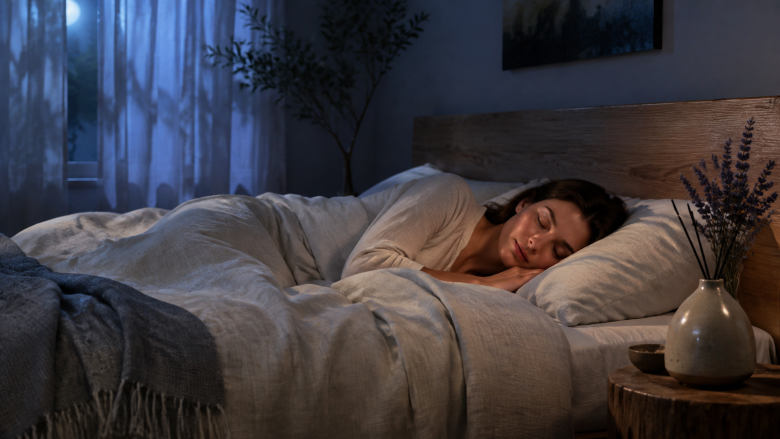
Your body needs to lower its core temperature by about 1 degree C to release the deep-sleep onset signal. A warm room fights that process. Most sleep scientists recommend a bedroom temperature around 18 degrees C (65 degrees F) for slow-wave-rich sleep.
What this looks like in practice:
- Set your thermostat to 18 degrees C, not 22 degrees C. If you don't have control, use a cooling blanket or a fan.
- Keep your feet warm. Cold feet can cause vasoconstriction, making you restless. Wear socks for the first 10 minutes, then remove them as you fade.
- Use thin layers you can kick off. The goal is to feel cool but not shivering.
My own mistake was going too cold. I once set the AC to 15 degrees C, woke up shivering with a headache, and then struggled to fall back asleep. The sweet spot for me was 18 degrees C with one light duvet.
Another edge case: if you're using a cooling mattress pad, set it slightly warmer than your room. A cold surface against your back can make you tense up and suppress the relaxation signal. Aim for a gentle cool, not a cold shock.
The Second Lever: Daytime Strength Training
Slow-wave sleep is the brain's way of paying back the physical repair debt you accumulate during waking hours. Resistance training is one of the most powerful natural ways to increase that debt. When you lift heavy, your muscles release myokines and your body increases the amount of slow-wave sleep in the next sleep cycle.
The timing matters. In my experience, morning or early afternoon strength training works best for deep sleep. If you train too close to bedtime, your core temperature stays elevated and adrenaline is still floating around, which can actually shrink your deep-sleep window. A good rule of thumb: finish any intense resistance session at least three hours before lights-out. Evening yoga, by contrast, is fine.
You don't need to become a powerlifter. Two or three 40-minute sessions per week with compound movements - squats, deadlifts, rows, presses - is enough. The important thing is that the effort is challenging enough to raise your breathing for extended sets.
The thing nobody tells you about exercise and sleep: the effect on deep sleep is not immediate. You might not see a change on the first night after a workout. In my tracking, deep sleep improves on the second night, after the delayed-onset muscle soreness peaks. So don't get discouraged if Monday's lift doesn't change Monday night. Look at the week as a whole.
A common mistake I see is adding a hard evening cardio session on top of strength training. Fatigue is not sleepiness. Two-a-day workouts can spike cortisol and actually lower slow-wave sleep in the early cycles. If you're already doing cardio, keep it at a conversational pace or move it to the morning.
The Third Lever: Magnesium Glycinate and the Right Nighttime Minerals
Supplements are not magic, but magnesium is the one I've seen move the needle more than any other. Magnesium glycinate - often sold as magnesium bisglycinate - is absorbed well and doesn't cause the laxative effect that magnesium oxide can. It activates the GABA system, helping you settle into a deeper sleep.
Here's the practical dosing strategy I use with people:
- Start with 200 mg of elemental magnesium glycinate about 60 minutes before bed.
- After three nights, if your sleep doesn't feel deeper, increase to 300 mg. I don't recommend going above 400 mg without a doctor's guidance.
- Skip it on nights when you've eaten a magnesium-rich meal (spinach, almonds, dark chocolate) to avoid overdoing it.
One thing nobody tells you: magnesium does not work like a sleeping pill. You won't feel drowsy after taking it. Instead, you'll simply wake up after a peaceful night and realize you didn't check the clock once. Consistency matters more than a single big dose.
Other supplements like glycine and L-theanine have some evidence, but they work better for sleep onset than for deep sleep. Melatonin, correctly, does not reliably increase slow-wave sleep; it's a shift-worker tool for regulating the clock, not a depth-enhancer. I gave up on melatonin years ago when my tracker showed no change in deep-sleep percentage.
The trade-off with magnesium glycinate: it can cause vivid dreams or vivid sleep inertia in some people. If you wake up groggy, try moving the dose to 45 minutes before bed instead of 60, or cut the dose by half. It's not a universal cure, and it won't override alcohol or a bad room temperature.
If you have kidney disease or are on blood pressure medication, talk to your doctor before copper-based supplements or magnesium powders. Magnesium is safe for most people, but it's still a supplement with a real physiological effect.
The Fourth Lever: Avoid Alcohol in the Deep-Sleep Window
Alcohol's reputation as a nightcap is dangerously wrong. A drink can make you drowsy and shorten sleep latency, but it actively fragments your sleep and suppresses the slow-wave sleep you're after. This is because alcohol alters the balance of GABA and glutamatergic activity, stealing the first part of the night when your brain would otherwise be building slow-wave waves.
According to the Sleep Foundation, even moderate alcohol can reduce deep sleep in the first half of the night and increase wakefulness in the second half. In my own tracking, a single glass of wine at dinner (around 7 pm) reduced my deep sleep from 1 hour 40 minutes to 45 minutes. That's a dramatic drop.
If you want to drink and still protect deep sleep, stop at least three hours before bedtime. That gives your liver time to process the initial peak. But the most severe effect comes from drinking within two hours of sleep. If you have a social event, aim to move the alcohol earlier in the evening and pair it with water.
The 'nightcap' myth persists because alcohol relaxes your jaw muscles and makes you feel zoned out. That's sedation, not deep sleep. You can be unconscious for eight hours and still spend most of the night in light stage N1 and N2 sleep. My test with a zero-alcohol month was the final proof: my deep sleep rose by 25 percent in the first week, and I hadn't changed anything else.
Anchoring Deep-Sleep Cycles with a Fixed Wake Time
Here's the counterintuitive tip: your wake-up time, not your bedtime, is the anchor for deep sleep. Deep sleep occurs mostly in the first two or three sleep cycles. The depth of those cycles is regulated by your circadian rhythm, which is set by morning light and activity.
When you wake up at the same time every day, you train your body to start secreting cortisol and bright-light exposure right after waking. That sets a timer for the next evening's slow-wave production. If you sleep in on weekends, you shift that timer forward, and Sunday night's first cycle gets shallower.
I recommend a consistent wake time even if you go to bed late. During my own 7-day experiments, I stopped hitting snooze and got up at 6 am no matter what. After two days of this, my deep sleep climbed from 45 minutes to 90 minutes even though my total sleep was identical. The wake-up signal is that powerful.
The mistake most people make is trying to fix a low deep-sleep night by staying in bed longer the next morning. That prolongs light sleep and delays the next circadian cycle. Instead, get up at your anchor time, expose yourself to daylight, and let the sleep pressure build. Your next deep-sleep window will thank you.
If you need help building a full wind-down routine, our simple evening wind-down routine pairs naturally with this anchor.
Using a Sleep Tracker Without Falling Into the Obsession Trap
You can't manage what you don't measure. But sleep trackers, especially classic wrist actigraphy, are estimates. They detect movement and heart rate, and derive sleep stages with algorithms. They're not medical-grade EEG, but they're excellent for spotting relative changes in your deep-sleep percentage from night to night.
What to do:
- Choose one tracker and stick with it for at least two weeks.
- Look at rolling 3-day averages, not single nights. Night-to-night variability is huge.
- Change one variable at a time, then watch for a shift in weekly average deep sleep.
- Don't check your sleep score the moment you wake up. That habit creates performance anxiety.
What can go wrong: I once spent a week obsessing over my overnight data, and my deep sleep got worse. The anxiety from checking the app blurred the signal. Now I only look at the data on Sunday mornings after I've had a week of sleep. Use the tracker as a research tool, not a judge.
If you don't have a tracker, use a subjective measure: ask yourself whether you feel physically restored when you wake up. That feeling usually tracks with slow-wave sleep. It's not a precise metric, but it's an honest one.
The Deep-Sleep Protocol: A Concrete Framework
Here's the actionable protocol I use when someone wants to improve deep sleep in four weeks. It combines the levers above into a daily routine.
| Lever | Timing | Dose or standard | Most common mistake |
|---|---|---|---|
| Strength training | Morning or early afternoon | 3 x 40-min sessions per week | Training within 3 hours of bed |
| Bedroom temperature | Throughout sleep | 18 degrees C (65 degrees F) | Using a thick duvet and freezing |
| Magnesium glycinate | 60 min before bed | 200-300 mg elemental | Taking a different magnesium salt that causes gut issues |
| No alcohol | At least 3 hours before bed | 0-1 drink maximum | Thinking a drink at dinner is fine |
| Fixed wake time | Same time every day | Even after a bad night | Sleeping in on weekends |
| Sleep tracker | Weekly review | Rolling 3-day average | Checking the score every morning |
The deep-sleep playbook is simple: make it cool, make yourself physically tired, give your brain the GABA support it needs, stop drinking before 9 pm, and wake up at the same time every day. Do that for a week, and your slow-wave average will likely climb by 20 to 30 percent.
If you want a more structured approach to build the habit, our 7-day plan to build better sleep habits walks through the first week step by step.
When Natural Approaches Are Not Enough
Deep sleep is not the only measure of good sleep. If you consistently spend less than 30 minutes in deep sleep per night, or if you wake up gasping, or your partner says you snore heavily, you may have sleep apnea. Sleep apnea fragments slow-wave sleep repeatedly and cannot be fixed with magnesium or temperature alone.
Talk to a doctor about a home sleep test or in-lab polysomnography. The National Heart, Lung, and Blood Institute has a clear overview of sleep deficiency and its health effects. Untreated apnea puts your heart and brain at long-term risk, so rule it out before you spend months fine-tuning your evening routine.
Another reason to seek help: if you're already doing the deep-sleep protocol and your tracker still shows very low slow-wave sleep, you might have an underlying condition like low growth hormone, chronic pain, or a medication side effect. Bloodwork can help identify the root cause. The natural levers are powerful, but they're not a substitute for medical diagnosis when the signal is clearly abnormal.